Many Lithuanian weddings take place at a countryside homestead (sodyba): a rented rural property with a hall, accommodation and grounds. When the homestead has no restaurant kitchen, the wedding food works if five things are in place: enough power, drinking water, a covered work area, vehicle access right up to the kitchen, and a rain plan. You can check all five on a single viewing, before you sign the contract. For wedding catering I bring my own equipment, food and team to the homestead, so these five things are exactly what I need from it.
What should you check at the homestead before signing?
All five questions fit into one walk around the grounds with the owner. Write the answers down: the kitchen will need them on the wedding day.
| Requirement | Why it matters for the food | What to ask the owner | What happens if it is missing |
|---|---|---|---|
| Power | Fridges keep the meat and cold dishes at a safe temperature, and warming equipment keeps the hot food hot. | “What is the homestead's permitted power? Can the kitchen have its own circuit that the band will not be plugged into?” | The breaker trips, and halfway through dinner both the kitchen and the musicians are left without power. |
| Water | Hands, vegetables, utensils and work surfaces get washed all day long. | “Is the tap water drinkable? Where is the nearest tap to where the kitchen will be?” | Water has to be brought in containers, and that needs to be known well before the day. |
| Covered work area and a grill spot | A roof protects the food from sun and rain. The grill needs an open spot away from buildings. | “Where can I put the grill so it is at least 6 m from the buildings? Where is there a roof nearby for the work tables?” | Cold dishes sit in the sun, and the grill ends up too close to a wall or too far from the tables. |
| Vehicle access | The equipment is heavy, and chilled food should not be carried by hand across the grounds for long. | “Can a car drive up to the kitchen spot, and does it get boggy there after rain? From what time can we drive in?” | Everything gets carried across the lawn, setting up takes longer, and the first course is late. |
| Rain plan | Grilling carries on in the rain, but serving in the open does not. | “Where will food be served if it rains, and how far is that from the grill? Is that room included in the price?” | It gets decided at the last minute, guests wait, and the food cools on the way. |
How much power does a wedding kitchen at a homestead need?
Enough for the fridges and warming equipment to run all evening, whatever the band is doing. The charcoal grill itself uses no electricity. Everything around it does: fridges, food warmers, the coffee machine, lighting for the work area after dark.
Ask the owner for two numbers. The first is the homestead's permitted power. In 2020 ESO, the Lithuanian distribution network operator, said it is granted in levels: 3, 4 or 5 kW for a single-phase supply, and 7 to 60 kW for three-phase. The second number is printed on the breaker that protects the circuit I will plug into. If it says 16 A, that circuit carries about 3.7 kW on a 230 V supply (230 V × 16 A). The limit is shared by every socket on the circuit: two appliances in different sockets split the same 3.7 kW.
At a wedding, the musicians, the lighting and sometimes a photo booth or a bouncy castle all plug into the same circuits. So I ask for a separate circuit for the kitchen, and once the menu is agreed I tell you in advance how much power my equipment will need. If the fuse board is a long way from the kitchen spot, agree who brings an extension lead rated for outdoor use.
When the homestead's power is not enough, the answer is a generator. PAGD says it must stand outdoors only, away from the building, with the exhaust pointed away from windows, doors and vents, because open windows and doors do not protect against carbon monoxide. Think about the noise as well: a generator next to the ceremony spot will be heard all through the vows.
What water is fit for food and handwashing?
Drinking water, running, and as close to the work area as possible. VMVT's recommendations for catering businesses say to wash hands with soap under warm running water for at least 30 seconds, before and after preparing food. When it assesses caterers, VMVT also checks that there is running drinking water and a handwashing sink where food is handled.
If the homestead gets its water from its own borehole or well, ask when it was last tested and whether the owners drink it themselves. If the answer is vague, tell me in advance: water for the food then has to be brought in, and that changes the preparation.
On the viewing, also ask where used water can be poured away and whether the kitchen team will have a toilet with a washbasin where they do not have to queue with the guests.
What work area does the chef need, and where does the grill go?
Two spots next to each other: a covered one for the tables and an open one for the fire. A gazebo, a lean-to or the end of a barn works for the tables, as long as the ground is level and firm and the cold dishes stay in shade all day. The spot should be close to the guest tables but away from the dance floor and where the children play. After dark it needs light.
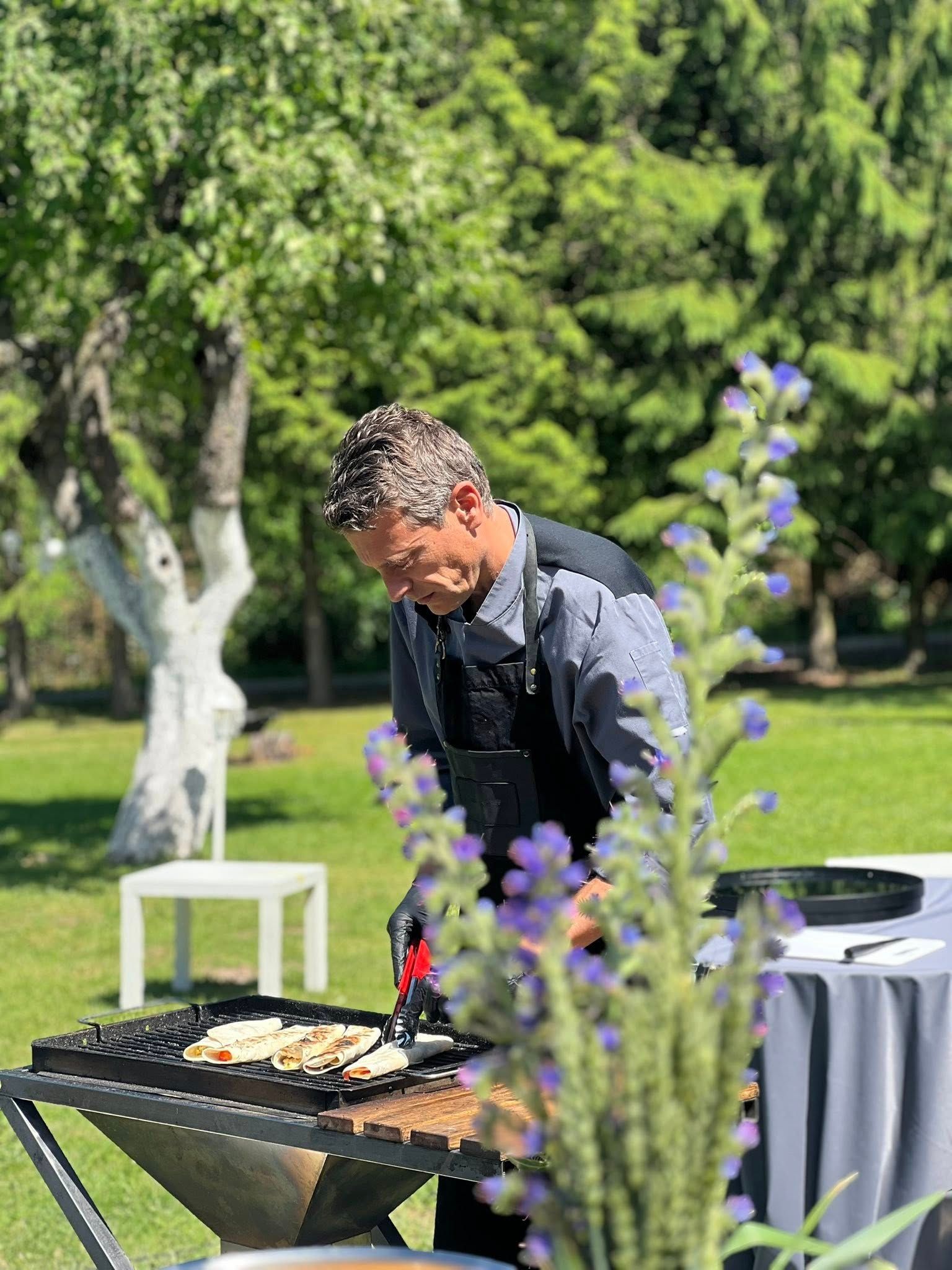
Fire safety decides where the grill goes. Point 25 of the General Fire Safety Rules (Bendrosios gaisrinės saugos taisyklės) allows barbecues, shashlik grills and smokers fired with solid fuel to be used no closer than 6 m to buildings. A campfire has to be further away: at least 30 m from buildings (point 18). Point 74 of the same rules bans solid-fuel barbecues indoors and on balconies and terraces unless the manufacturer's instructions say otherwise. So a covered homestead terrace is fine for serving food, but the charcoal grill belongs in the yard.
The rules set no separate distance for a marquee. PAGD advises against putting barbecues near tents, plastic chairs and tables, fences and hedges, so I pick a spot where the wind carries smoke and sparks away from the marquee. The grill goes on a non-combustible base (dry grass will not do), with water kept next to it. At fairs and outdoor markets, the rules require a 6 kg fire extinguisher and a fire blanket next to a grill like this. That point is not written for a private party, but an extinguisher by the fire is useful there too. Agree whose it will be: the homestead's or the kitchen's.
If you are still deciding whether your homestead suits live fire or a classic sit-down dinner better, there is a comparison in my article on a grill or a banquet for a wedding.
How do you keep food safe outdoors?
Cold food is kept cold, hot food is kept hot, and everything on the table has a time limit. Guests never see this part, but it decides how many fridges and how much shade you need from the homestead.
| What | Limit | Source |
|---|---|---|
| Perishable ingredients and cooked food in the fridge | 0 to +6 °C | VMVT recommendations |
| Cooked food at room temperature | no more than 2 h | VMVT recommendations |
| The same food when it is above 32 °C outside | no more than 1 h | FDA (USA) |
| Cooked food that is served hot | no lower than +63 °C | VMVT assessment procedure |
| Cooled hot food in the fridge | no higher than +4 °C, for no more than 24 h | VMVT recommendations |
For the homestead, that means four things.
- Ask whether the kitchen can use the homestead's fridge and how much space will be free in it. The same fridge is often promised to the chef, the cake and the drinks all at once. The meat quantity calculator gives a rough idea of how much meat will need chilling.
- The starters table goes in the shade. Cold dishes come out in batches and are topped up from the fridge, so no plate sits out longer than the table above allows.
- VMVT says to use separate boards and knives for raw meat, poultry and seafood, and to keep raw ingredients apart from ready food. So the work area has to fit more than one table. I have listed the core temperatures different meats need to reach in my cooking temperature chart.
- If you plan to make the next day's breakfast from the wedding food, tell me in advance. Anything that sat on the table for a few hours is not fit for the next day. Food for day two is set aside and chilled separately before it ever reaches the table, and once reheated, according to VMVT recommendations, it should be eaten within an hour.
What if it rains on the wedding day?
The grilling carries on outside and the serving moves under a roof. The grill does not go into a closed marquee, barn or hall in any weather.
Burning charcoal gives off carbon monoxide. PAGD describes it as an extremely poisonous gas with no colour or smell, and lists barbecues used indoors among the sources of danger. The US Centers for Disease Control and Prevention (CDC), after describing the deaths of campers in a tent where a charcoal grill had been brought in, state that such devices must not be used inside a tent or any other enclosed shelter, and that opening the sides of the tent does not stop carbon monoxide from building up.
A rain plan that works has five parts.
- The grill stays in the open, at the same distance from buildings. Keeping the person grilling covered in the rain is my job. All I need from the homestead is for that spot not to turn into a puddle after a downpour.
- The work tables and the food stay under a roof. If the shade of a tree was enough on a clear day, rain needs a proper shelter.
- Serving moves indoors: into the hall, onto a covered terrace or into the wedding marquee. The shorter and better covered the route from the grill to the table, the hotter the food is when it reaches the plate.
- The menu has a rain version. We agree in advance what gets grilled in front of the guests on a dry day and what comes out ready-made if it rains.
- It is clear who calls plan B and by what time: you, the planner or the chef. Otherwise it gets decided with the guests already seated.
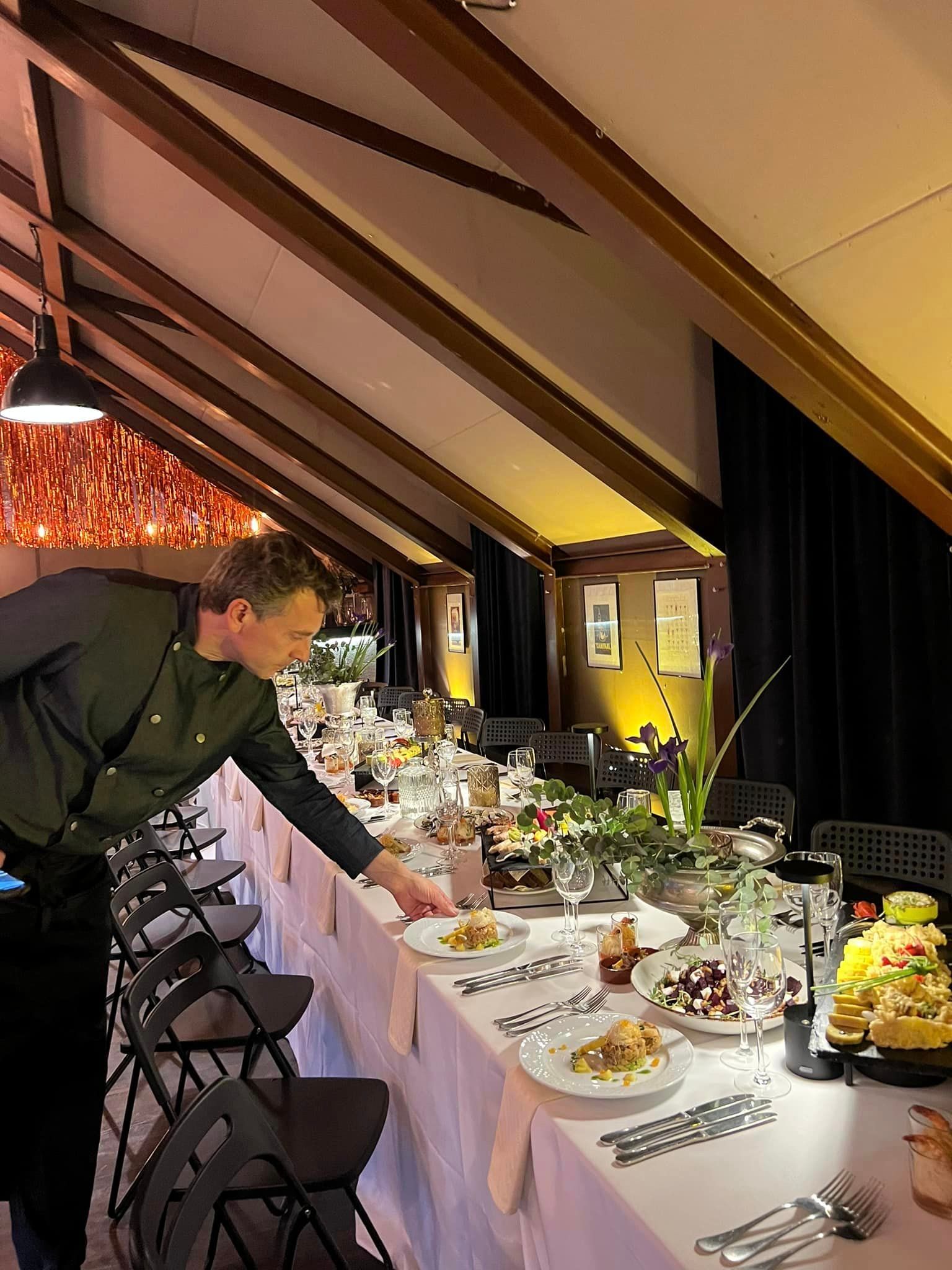
Ask the owner whether the hall can be used at no extra charge if it rains and that it has not been let to anyone else that day. I have written a fuller plan for adapting an outdoor event to the weather in my article on organising an outdoor event.
What does the wedding day look like from the kitchen?
A typical day has seven stages, and each needs at least one arrangement with the homestead. The times depend on your programme, so we agree them separately.
| Stage | What happens in the kitchen | What to agree with the homestead |
|---|---|---|
| 1. Arrival | Equipment and food are unloaded. Chilled food goes straight into the cold. | From what time we can drive in, who unlocks the gate, where the car will be parked. |
| 2. Setting up | Tables go up, the fridges are plugged in, the grill spot is prepared. | Which circuit, which tap and which fridge are for the kitchen. |
| 3. Fire | The charcoal is lit. Until it burns down to embers, there is smoke. | Where the ceremony and the photo shoot will be, so the smoke does not drift their way. |
| 4. First course | Starters for guests coming back from the ceremony. | Where the starters table will stand (in the shade) and who looks after the crockery and drinks. |
| 5. Hot dishes | Grilling and serving follow the evening's programme. | The route from the grill to the tables is clear and lit after dark. It is clear who switches on the lights in the work area. |
| 6. Late-night snack | A later, simpler serving. | Until what time we can grill outside, and when quiet hours start at the homestead. |
| 7. Packing up | The coals are put out, the rubbish is sorted, the equipment is loaded. The grill is not left while the embers are still smouldering. | By what time we must leave, where to leave the rubbish and the cooled ashes, who gets the keys back. |
What should the homestead contract say about the food?
A verbal “it'll be fine” does not help on the wedding day, because the owner may not even be at the homestead then. Ask for the contract or an annex to it to state:
- that you can bring your own catering team, and whether there is an extra fee for it;
- from what time the kitchen team can drive in and by what time they must leave;
- how much power and which circuit the kitchen gets;
- where the grill can be lit;
- that the kitchen can use the water, the fridge and the homestead's own kitchen, if it has one;
- which room is set aside for serving if it rains;
- who takes the rubbish away and where cooled ashes go;
- when quiet hours start at the homestead.
What to ask the chef and what makes up the catering price I have covered separately: wedding catering prices, menus and planning.
A checklist to take to the homestead viewing
Print it or open it on your phone and tick items off as you walk round. Ask the owner in writing about anything you could not tick, so you have the answer on record.
Homestead viewing checklist
0 of 18
Frequently asked questions
Can I hire a chef for a homestead that has no kitchen?
Yes. I arrive with my own equipment, food and team, so the homestead does not need a restaurant kitchen. What I need from it is five things: enough power, running drinking water, a covered work area, vehicle access and an outdoor spot for the grill at least 6 m from buildings. Before you sign, also check that the homestead allows you to bring in your own caterer.
How much electricity does wedding catering at a homestead need?
It depends on the menu and the number of guests, so I give you an exact figure once the menu is agreed. Ask the owner for the homestead's permitted power and for a separate circuit for the kitchen. The levels ESO published in 2020 are 3, 4 or 5 kW for a single-phase supply and from 7 kW for three-phase. One circuit protected by a 16 A breaker carries about 3.7 kW for everything plugged into it combined.
Can you barbecue in a marquee when it rains?
No. Burning charcoal gives off carbon monoxide, a colourless, odourless gas that builds up in an enclosed space. The US Centers for Disease Control and Prevention (CDC) state that charcoal grills must not be used inside a tent and that opening the sides does not protect against this. When it rains, the grill stays outside and only the serving moves into the marquee or the hall.
How far from homestead buildings can a charcoal grill go?
At least 6 m from buildings. That comes from point 25 of the General Fire Safety Rules (Bendrosios gaisrinės saugos taisyklės), which covers barbecues, shashlik grills and smokers fired with solid fuel. A campfire has to be at least 30 m from buildings. Solid-fuel barbecues are banned indoors and on balconies and terraces unless the manufacturer's instructions say otherwise.
How long can food sit out on a table outdoors?
The State Food and Veterinary Service (VMVT) recommends keeping cooked food at room temperature for no more than 2 hours. The US Food and Drug Administration (FDA) says that above 32 °C outside, the limit drops to 1 hour. So cold starters go in the shade and come out in batches, while the rest waits in the fridge at 0 to +6 °C.
What if the homestead does not have enough power?
First ask the owner whether the kitchen can have a different circuit and what can be switched off during the evening, such as the sauna or the water heater. If that is still not enough, the answer is a generator. The Fire and Rescue Department (PAGD) says it must stand outdoors only, away from the building, with the exhaust pointed away from windows and doors. Tell me about this in advance, because the power available decides what equipment I bring.
Sources
- General Fire Safety Rules (Bendrosios gaisrinės saugos taisyklės), consolidated version from 1 November 2025 (in Lithuanian)— points 18, 25 and 74, Annex 5 point 25. Register of Legal Acts.
- PAGD: firefighters remind people of the key safety rules (23 June 2026) (in Lithuanian)— barbecues and tents, campfires.
- Klaipėda City Municipality: “How to light a barbecue safely” (in Lithuanian)— non-combustible base, water nearby, ashes.
- Environmental Protection Department: how to light campfires and use barbecues safely outdoors (11 August 2023) (in Lithuanian)— campfires and barbecues in forests.
- LRT: Lithuania restricts access to forests due to fire hazard (16 June 2023)— 14 municipalities restricted access to forests.
- VMVT: “How to prepare food properly and avoid cross-contamination”, recommendations for catering businesses (in Lithuanian)— storage temperatures, the 2-hour limit, handwashing.
- VMVT Director's order on the procedure for assessing catering businesses' compliance with hygiene requirements, consolidated version from 15 February 2024 (in Lithuanian)— hot food held at no lower than +63 °C, running drinking water.
- FDA: Handling Food Safely While Eating Outdoors (2024)— the 1-hour limit above 32 °C outside.
- CDC MMWR: Carbon Monoxide Poisoning Deaths Associated with Camping, Georgia, March 1999— charcoal grills inside a tent.
- PAGD: carbon monoxide detectors can save you from poisoning (31 January 2023) (in Lithuanian)
- PAGD: “How to use an electric generator safely?” (24 August 2026) (in Lithuanian)
- ESO: “Decide on and use only as much power as you need” (1 April 2020) (in Lithuanian)— permitted power levels.