Chicken is done when a thermometer in the thickest part reads 75 °C. Mince and sausages need the same, fish is fine at 63 °C, and a medium rare beef steak is about 56 °C after resting. The first three figures are safety thresholds; the fourth is a matter of taste. All temperatures here are in degrees Celsius, and every safety threshold comes with the name of the authority that publishes it.
What is the difference between a safe temperature and doneness?
A safe internal temperature is the point at which the bacteria that cause illness are killed. Doneness describes how the meat looks when you cut it and what its texture is like. For poultry, mince and sausages the two are the same thing: they are cooked to the safety threshold. Only whole cuts of beef and lamb are different.
The UK Food Standards Agency (FSA) explains it like this: on a whole cut, such as a steak or a joint, bacteria are only found on the outside, so once the surface is well seared the middle can stay pink. In poultry and pork, bacteria can be present throughout. In minced and skewered meat the surface ends up on the inside, so it has to be cooked through as well.
In Lithuania, VMVT gives a single general threshold: the inside of a cooked product must reach at least 75 °C. The UK FSA and Germany's Federal Institute for Risk Assessment (BfR) define the same level of safety as 70 °C held for 2 minutes. The FSA also lists equivalent combinations: 60 °C for 45 min, 65 °C for 10 min, 75 °C for 30 seconds, 80 °C for 6 seconds. US agencies set thresholds by product: 74 °C for poultry, 71 °C for minced meat, and 63 °C with a 3-minute rest for whole cuts of beef, pork and lamb.
Where the sources disagree, I take the strictest figure, 75 °C, for poultry, mince and sausages. A few extra degrees do a burger or a chicken thigh no harm.
Steak temperatures by doneness
A medium rare steak is about 56 °C after resting, medium 60 °C, well done 71 °C. Take the steak off the heat 2–4 °C early, because it keeps warming up as it rests.
| Doneness | Take off the heat | After resting | What it looks like inside |
|---|---|---|---|
| Blue | 45–47 °C | 49 °C | Only the surface browned, inside dark red and cool |
| Rare | 48–50 °C | 52 °C | Red, warm centre |
| Medium rare | 52–54 °C | 56 °C | Red-pink centre, browner edges |
| Medium | 56–58 °C | 60 °C | Pink all the way across, no red left |
| Medium well | 61–63 °C | 65 °C | Brownish, with pink only in the very centre |
| Well done | 67–69 °C | 71 °C | Greyish brown all the way through |
| Official US threshold for a whole cut | 63 °C | 63 °C or above | With the recommended 3-minute rest; roughly between medium and medium well |
The figures from rare to well done come from the chart published by the thermometer maker Thermapen, and the figure for blue from the chart of the butcher Pryde Butchery. Other charts may put the same level a few degrees higher or lower, because this is a convention among cooks and there is no official standard.
The table applies to a whole cut of beef, veal or lamb with a well-seared surface. It does not apply to burgers, rolled joints or skewers: they follow the safety thresholds in the next table. I've written about choosing a cut, preparing it and searing it in the post on cooking steak at home, and about lamb in the post on grilling lamb.
Safe internal temperatures for meat, poultry and fish
If you want one number for everything, it is 75 °C: that is the core temperature VMVT gives. By product the thresholds are more precise, and the European and US figures do not always agree. The numbers in the last column refer to the list of sources at the bottom of the page.
| Food | What to go by | United Kingdom, Germany | USA | Sources |
|---|---|---|---|---|
| Poultry: whole bird, portions, mince | 75 °C | Cook through: 70 °C for 2 min | 74 °C | 1, 2, 5, 9 |
| Mince, burgers, meatballs and patties | 75 °C | Cook through: 70 °C for 2 min | 71 °C | 1, 3, 6, 9 |
| Fresh sausages, grilling sausages | 75 °C | Cook through | 71 °C | 1, 6, 11 |
| Shashlik and kebabs (meat on skewers) | 75 °C | Cook through | Depends on the type of meat | 1, 5, 6 |
| Pork, whole cut: loin, neck (collar), roasting joint | 75 °C, or 70 °C held for 2 min | Cook through: 70 °C for 2 min or 65 °C for 10 min | 63 °C plus a 3-minute rest | 1, 5, 6, 9 |
| Pork shoulder for pulled pork, ribs | Safe from 75 °C; shoulder turns tender at 91–95 °C | Cook through | 63 °C plus a 3-minute rest | 1, 9, 19 |
| Wild boar, home-reared pork | Only once tested for Trichinella, then 75 °C | – | – | 1, 4 |
| Beef, veal, lamb: steaks, joints, whole cuts | See the steak table; 70–75 °C for vulnerable groups | Sear the outside well, inside to taste | 63 °C plus a 3-minute rest | 5, 6, 8, 9 |
| Rolled joints, roulades | 75 °C | Cook through | – | 1, 6 |
| Fish: whole or fillets | 63 °C; flesh opaque and flakes easily | Until the flesh is no longer glassy | 63 °C | 8, 9, 11 |
| Prawns, lobster, crab, scallops | Until the flesh is pearly and opaque | – | No temperature given; judged by appearance | 9, 11 |
| Mussels, oysters | Until the shells open during cooking | – | Until the shells open | 9, 11 |
| Reheated food, leftovers | 75 °C; bring sauces and soups to the boil | Until steaming hot throughout; reheat only once | 74 °C | 1, 5, 9 |
| Keeping hot food on the table | No lower than 63 °C | UK: 63 °C or above; Germany: 60 °C or above | The danger zone ends at 60 °C | 6, 7, 8, 10 |
The US figures are converted from Fahrenheit: 145 °F is 63 °C, 160 °F is 71 °C, 165 °F is 74 °C.
Pork: why there are three different figures
The general VMVT threshold is 75 °C. The UK FSA puts pork among the meats that must be cooked through; its table gives 70 °C held for 2 min, or 65 °C held for 10 min. US agencies give 63 °C and a 3-minute rest for a whole cut of pork.
For pork neck the difference doesn't matter: it is fatty and stays juicy at 75 °C. Lean loin is already on the dry side at 75 °C, so I keep it over indirect heat until the thermometer has shown at least 70 °C for 2 minutes. Don't judge by colour: pork can be pink and still have reached a safe temperature.
According to Lithuania's National Public Health Centre, wild boar and meat from home-reared pigs must always be tested for trichinellosis and must not be eaten until the lab result is in. Inside a large piece, Trichinella larvae can survive even boiling or roasting, and salting and smoking only kill them in the outer layers.
Shoulder and ribs: why the safe temperature is not enough
Pork shoulder is safe at 75 °C, but at that point it is still tough. Connective tissue needs a higher temperature and time to break down: ThermoWorks gives an internal temperature of 91–95 °C for pulled pork. That is why shoulder and ribs are cooked over indirect heat at a low temperature for several hours. There is more on this in the post on smoking basics for beginners.
Shashlik and skewers
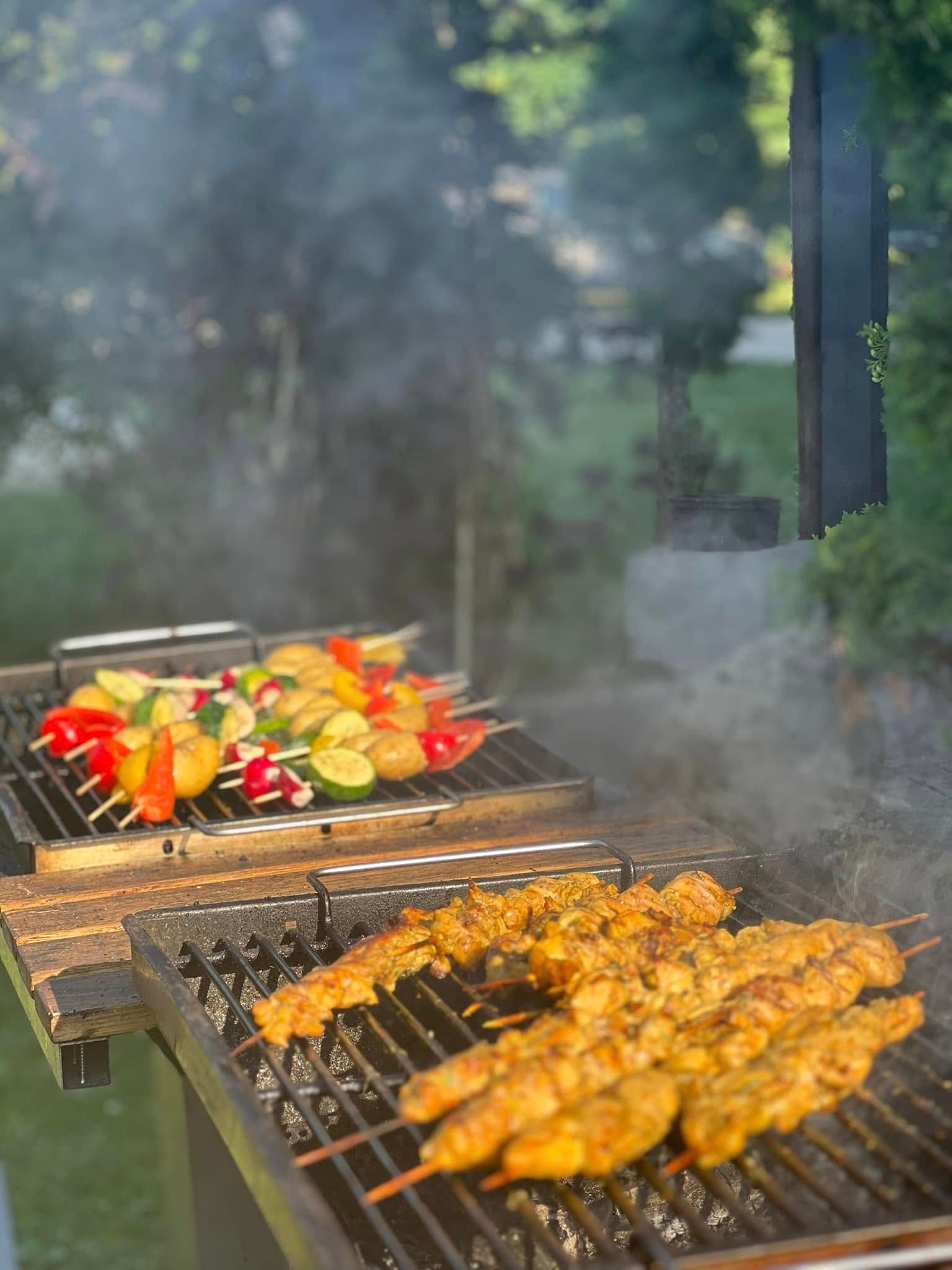
For shashlik the figure is the same as for mince, 75 °C. The FSA says skewered meat must be cooked through, because the skewer carries surface bacteria into the middle of the piece. Measure the thickest piece and push the probe in from the side so that it doesn't touch the skewer. Marinated meat is cooked to the same temperature as unmarinated; for quantities and marinating times, see my shashlik marinade recipes.
Fish and seafood
For fish, US agencies give 63 °C or a visual sign that the BfR also mentions: the flesh is opaque and separates easily into flakes with a fork. No temperature is given for prawns, scallops or mussels; they are judged by how they look. I've covered grilling them in the post on seafood on the grill.
How much does meat rise in temperature while resting?
A small piece, such as a steak or a chicken breast, rises another 2–7 °C after it comes off the heat; a large joint or a whole bird rises 6–12 °C. During cooking the outer layers get hotter than the middle. Once the meat is off the heat, that heat keeps moving towards the cooler centre until the temperature evens out.
There is no exact figure; the sources give ranges. ThermoWorks gives at least 2 °C for a small piece and up to 6–8 °C for a large roast or a turkey. The Thermapen steak chart says 2–4 °C, while another chart from the same maker gives 5–7 °C for small steaks and chops and 10–12 °C for a large joint.
How much your piece will rise depends on its size, the heat it was cooked over and where it rests. A thick, round piece holds more heat than a thin, flat one. Meat seared hard rises more than meat cooked slowly at a low temperature. Meat loosely covered with foil keeps its heat, while meat set on a cold plate loses it.
For a steak, chop or chicken breast, Thermapen recommends 5–10 min of resting, and 30 min or more for large joints and whole birds. The meat has rested once the temperature peaks and starts to fall.
How to measure the internal temperature correctly
Push the probe into the thickest part of the piece, right to the centre, without touching bone, a layer of fat or the grate, and wait until the number stops changing. Food safety specialists at Penn State University stress that the colour of the meat, clear juices and texture are not reliable signs; only a thermometer is.
| Food | Where to measure |
|---|---|
| Steak, chop, chicken breast | From the side, horizontally, to the centre of the thickest part, away from bone and fat |
| Burger, patty | From the side, so that the tip of the probe sits right in the middle |
| Whole chicken, turkey | The deepest part of the thigh and of the wing where it joins the body, and the thickest part of the breast, never touching bone |
| Thighs, drumsticks, wings | The thickest part, not touching bone |
| Large joint, shoulder | The centre of the thickest part, away from bone, fat and sinew; check in two places |
| Shashlik, skewers | The thickest piece, from the side, not touching the skewer |
| Stews, sauces | The middle of the pot, after stirring, not touching the bottom |
Instant-read or leave-in thermometer?
An instant-read digital thermometer gives a reading in 2–10 seconds, and its sensor is in the tip of the probe, so it can measure thin pieces too. It isn't left in the meat; you use it to check at the end of cooking. A dial thermometer needs 15–20 seconds and has to go in 5–6 cm deep, which makes it hard to use on a thin piece.
A leave-in thermometer, either ovenproof or on a cable, stays in the meat the whole time it cooks. It is meant for large joints, whole birds and long, slow cooking at low temperatures. If you are buying only one, get an instant-read digital one: it will do for steak, chicken and shashlik alike.
How to check your thermometer is telling the truth
- Fill a glass with crushed ice, add cold water up to the top of the ice and stir.
- Put the probe in at least 5 cm deep, without touching the sides or bottom.
- Wait about 30 seconds for the reading to settle. It should read 0 °C; the acceptable range is −1 to 1 °C.
- For a second check, put the probe in boiling water: it should read 99–101 °C.
- If the reading falls outside these ranges, recalibrate the thermometer if it can be adjusted; if it can't, replace it.
Specialists at North Dakota State University (NDSU) advise checking at least once a month and every time the thermometer is dropped. Wash and wipe the probe between raw and cooked meat.
What temperature should the grill be?
A steak needs 260–290 °C of direct heat, chicken 190–230 °C, and ribs and shoulder around 107–135 °C of indirect heat. These are the ranges given by the grill maker Weber. The lid thermometer shows the air temperature inside the grill; you still need a probe to measure the inside of the meat.
| Zone | Temperature | What to cook there |
|---|---|---|
| Direct, high | 260–290 °C | Steaks, thin pieces of seafood: anything that cooks in 20 min or less |
| Direct, medium-high | 230–260 °C | Burgers, lamb chops, salmon fillets |
| Direct, medium | 190–230 °C | Chicken breasts, bone-in thighs and drumsticks, thick pork chops |
| Indirect, medium | 190–220 °C | Whole birds, larger joints of meat, vegetables |
| Indirect, low | 107–135 °C | Ribs, pork shoulder, beef brisket |
The easiest setup is a grill with two zones: you sear the meat over the coals and finish it next to them until it reaches the right internal temperature. That way a thick chicken thigh gets to 75 °C without burning on the outside. To work out which grill makes this easier, read about the difference between charcoal and gas grills.
How long can cooked food stay out on the table?
Keep hot food at 63 °C or above and cold food at 6 °C or below, and eat anything left at room temperature within 2 hours. In between, bacteria multiply quickly: the UK FSA calls 8–63 °C the danger zone, and US agencies roughly 4–60 °C.
- VMVT says perishable products and cooked food should be kept at 0–6 °C.
- According to VMVT, cooked food can stand at room temperature for no more than 2 h. US agencies cut that to 1 h when it is above 32 °C outside.
- Under UK rules, hot food is kept at no less than 63 °C. It may be held below that once, for up to 2 h, after which it must be cooled to 8 °C or thrown away. The BfR minimum is 60 °C.
- Reheat leftovers to 75 °C and bring sauces and soups to the boil. The FSA advises reheating the same food only once.
At a countryside homestead (sodyba) or in a back garden, keep raw meat in a cool box with ice, in the shade, until it goes on the grill. Have separate tongs and plates for raw and cooked meat. Cook in batches and bring to the table only as much as will be eaten straight away, so that a bowl of shashlik isn't sitting in the sun all afternoon. I've covered choosing the spot, timing and a backup plan for bad weather in my guide to organising an outdoor event.
Frequently asked questions
What temperature should chicken be cooked to?
Chicken is done when a thermometer in the thickest part, away from the bone, reads 75 °C. That is the core temperature recommended by the State Food and Veterinary Service (VMVT), Lithuania's food safety authority. US agencies give 74 °C, and the UK Food Standards Agency (FSA) gives 70 °C held for 2 minutes. On a whole bird, check deep in the thigh and in the thickest part of the breast. The colour of the meat and clear juices are only secondary signs.
Is pink pork safe to eat?
Colour tells you nothing about safety: pork can still be pink after it has reached a safe temperature, so go by the thermometer. VMVT recommends 75 °C, the UK and German authorities 70 °C held for 2 minutes, and the US gives 63 °C plus a 3-minute rest for whole cuts. Minced pork and sausages are cooked to 75 °C, and wild boar or home-reared pork must be tested for Trichinella first.
What temperature is a medium rare steak?
A medium rare beef steak is about 55–56 °C after resting. Take it off the heat at 52–54 °C: during 5–10 minutes of resting it rises another 2–4 °C. Medium rare is a culinary doneness level, below the 63 °C threshold published by US agencies, so it only applies to a whole piece of beef with a well-seared surface.
Is it safe to eat a rare steak?
On a whole cut of beef or lamb the bacteria sit on the surface, so the UK FSA allows such a steak to be served pink as long as the outside is well seared. US agencies still recommend 63 °C and a 3-minute rest. For young children, pregnant women, older people and anyone with a weakened immune system, cook steak all the way through. Burgers are not covered by this exception: minced meat is cooked to 75 °C.
How long should meat rest after cooking?
A steak, chop or chicken breast needs 5–10 minutes; a large joint or a whole bird needs 30 minutes or more. Meanwhile the core temperature keeps climbing: by 2–7 °C in a small piece and 6–12 °C in a large one. For whole cuts of beef, pork and lamb, US agencies specify a rest of at least 3 minutes once they reach 63 °C.
How do I check that a meat thermometer is accurate?
Fill a glass with crushed ice, top it up with cold water, stir, and put the probe in at least 5 cm deep without touching the sides or bottom. After half a minute it should read 0 °C, give or take one degree. In boiling water it should read 99–101 °C. If it doesn't, recalibrate it or replace it.
Sources
- VMVT, “How to cook food properly and avoid cross-contamination: recommendations for catering businesses” (in Lithuanian)— at least 75 °C inside the product, storage at 0–6 °C, up to 2 h at room temperature
- VMVT, “VMVT warns: salmonella is not only in eggs” (19 March 2026) (in Lithuanian)— a core temperature of no less than 75 °C recommended for meat and eggs
- National Food and Veterinary Risk Assessment Institute, “Zoonoses” (updated 10 January 2024) (in Lithuanian)— E. coli, salmonella, campylobacter, at-risk groups
- National Public Health Centre, “Trichinellosis” (updated 20 November 2023) (in Lithuanian)— testing wild boar and home-reared pork
- Food Standards Agency (GOV.UK), “Cooking your food”— 70 °C for 2 min and equivalent combinations; whole cuts, minced and skewered meat
- Food Standards Agency (GOV.UK), “Cooking food safely”, food hygiene for businesses— what must be cooked through, hot holding at 63 °C and the 2-hour rule
- Food Standards Agency, “Guidance on Temperature Control Legislation in the United Kingdom” (2016)— the 8 °C and 63 °C limits, permitted periods outside temperature control
- Bundesinstitut für Risikobewertung (BfR), “Protection against foodborne infections in private households” (2020)— 70 °C for 2 min, hot food at no less than 60 °C, more vulnerable groups
- U.S. Food and Drug Administration, “Safe Food Handling” (5 March 2024)— US table of safe minimum internal temperatures
- Centers for Disease Control and Prevention, food safety prevention page (24 November 2025)— danger zone 40–140 °F, the 2-hour and 1-hour rules
- National Institute of Standards and Technology, “Metric Kitchen: Culinary Temperature” (updated 29 April 2026)— USDA FSIS limits in degrees Celsius: 62.8, 71.1 and 73.9 °C
- Penn State Extension, “Food Thermometers: Essential for Food Safety and Quality” (1 July 2024)— types of thermometer, the ice-water test, why colour is unreliable
- NDSU Extension, FN1348 “Keep Hot Foods Hot and Cold Foods Cold” (reviewed January 2026)— checking a thermometer at 0 °C and 100 °C
- Academy of Nutrition and Dietetics, “A Short Guide to Food Thermometers” (reviewed 10 November 2025)— where to insert the probe, food by food
- Centre for Food Safety (Hong Kong), “Food thermometers”— acceptable readings: −1 to 1 °C in ice, 99–101 °C in boiling water
- Thermapen (ETI), “Steak Cooking Chart”— pull and final temperatures for steak; a culinary source
- Thermapen (ETI), “Why Meat Keeps Cooking as It Rests”— temperature rise during resting and resting times by cut
- ThermoWorks, “Resting: The Final Phase of Cooking”— why meat keeps heating up off the grill
- ThermoWorks, “Pork Internal Temps: Pink Pork Can Be Safe to Eat”— pork colour, and 91–95 °C for shoulder
- Pryde Butchery, “Steak Doneness Temperature Chart”— temperature for blue; a culinary source
- Weber, “Direct cooking on a premium gas barbecue”— direct heat ranges
- Weber, “How to Cook Anything on Your Grill: Mastering Direct, Indirect, and 2-Zone Grilling”— indirect heat ranges, converted from °F