Two things decide the catering format for a summer party: how many people are coming, and whether the evening is built around speeches or around people chatting freely. For a team of up to about 40 I usually suggest a sit-down dinner; a larger group suits a live grill with a buffet; and when the programme runs all day, I split the catering into two rounds. Budget €35–65 per person for food and service. The venue, drinks, programme, transport and marquee are separate budget lines.
Which catering format suits a company summer party?
Choose by what people will be doing between bites. If you want colleagues from different departments to mix, they need a reason to walk around: a grill, a buffet or several food stations. If the main point is management's speeches and the awards, people need to be seated. The table compares five formats and what each one needs from the venue.
| Format | Best for | Guests | What the venue needs | How long the meal takes | Effect on mingling |
|---|---|---|---|---|---|
| Live grill with a buffet | A relaxed party where you want people from different departments to mix | 30–300+ | Outdoor space for the grill, a roof over the buffet, seats for at least some of the guests | 1.5–2 h | Helps: people move between the grill, the buffet and the tables, so they run into each other |
| Sit-down dinner | A smaller team, or an evening with speeches or awards | 10–60 | Tables and chairs for everyone, a roof over every table | 2–3 h, courses served in stages | People talk to whoever sits next to them, so the seating plan needs some thought |
| Standing buffet with grilled bites | A short after-work evening, or a party with clients or partners | 30–200 | High tables, a modest space, room outside for the grill | 1–1.5 h | Helps the most, because nobody sits down. It won't replace a proper dinner |
| Family day | A party where staff bring their partners and children | 50–300+ | A safe, enclosed area, shade, a children's zone well away from the grill | 2–3 h, children eat first | Families get to know each other, and there is less talk about work |
| All-day event with two meals | A team-building day or an away day with a programme | 30–200 | Space for a kitchen for the whole day, electricity, water, refrigeration | Two rounds: a lighter lunch and dinner from the grill | The programme gets people talking; the food gives them breaks |
Live grill with a buffet
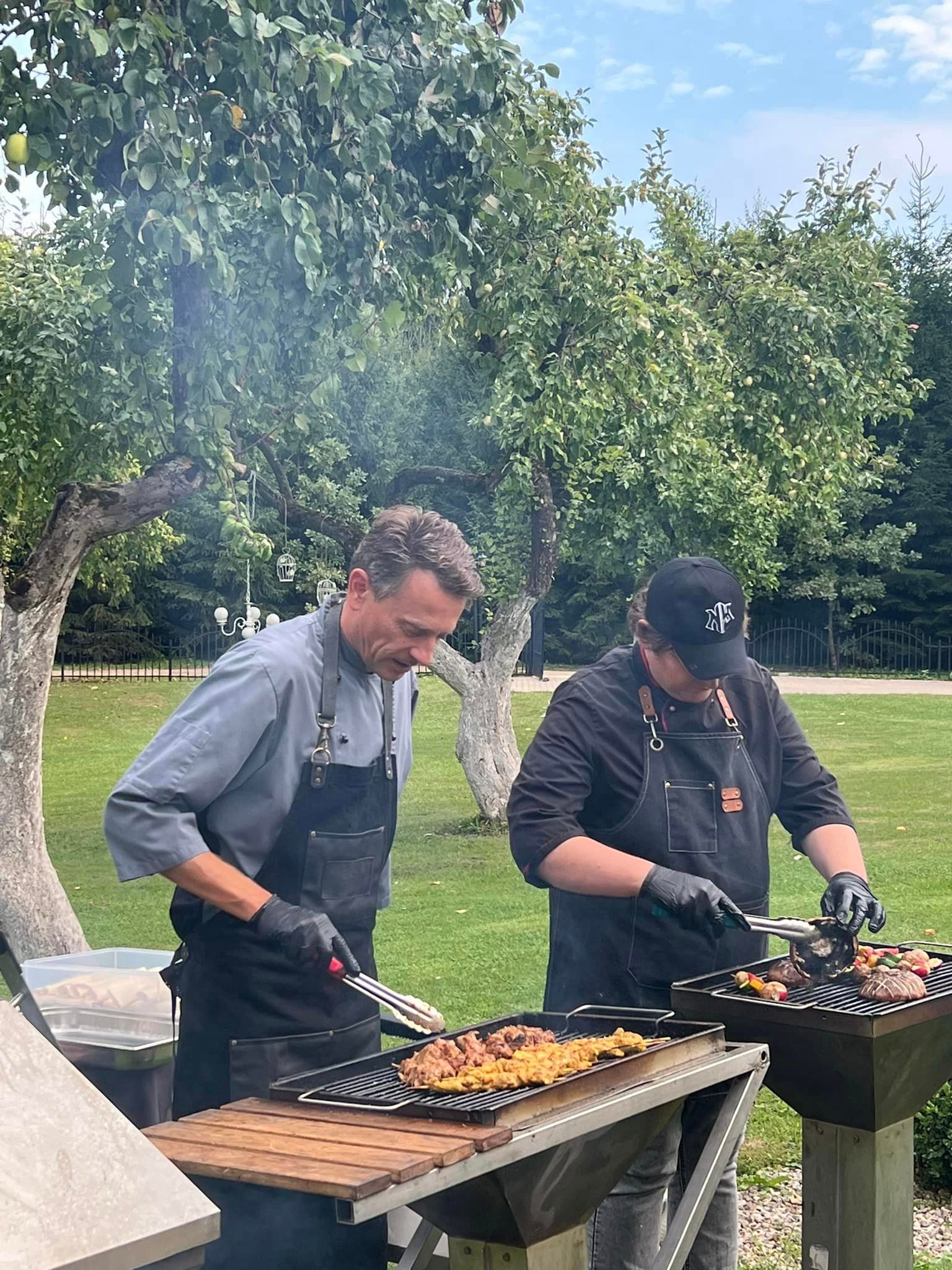
Meat and vegetables are grilled in front of the guests, while sides, salads and sauces sit on a buffet where people help themselves. The format copes with 50 people or 300; at a large party you just need several food stations instead of one queue. Not everyone needs a seat, but the buffet does need a roof.
Sit-down dinner
This works when the team fits around a few tables and the evening has a running order with speeches and awards. Dishes from the grill come out in stages, so the programme can slot in between them. At the table people spend the whole evening talking to the same neighbours, so it is worth serving dessert and coffee separately, standing.
Standing buffet with grilled bites
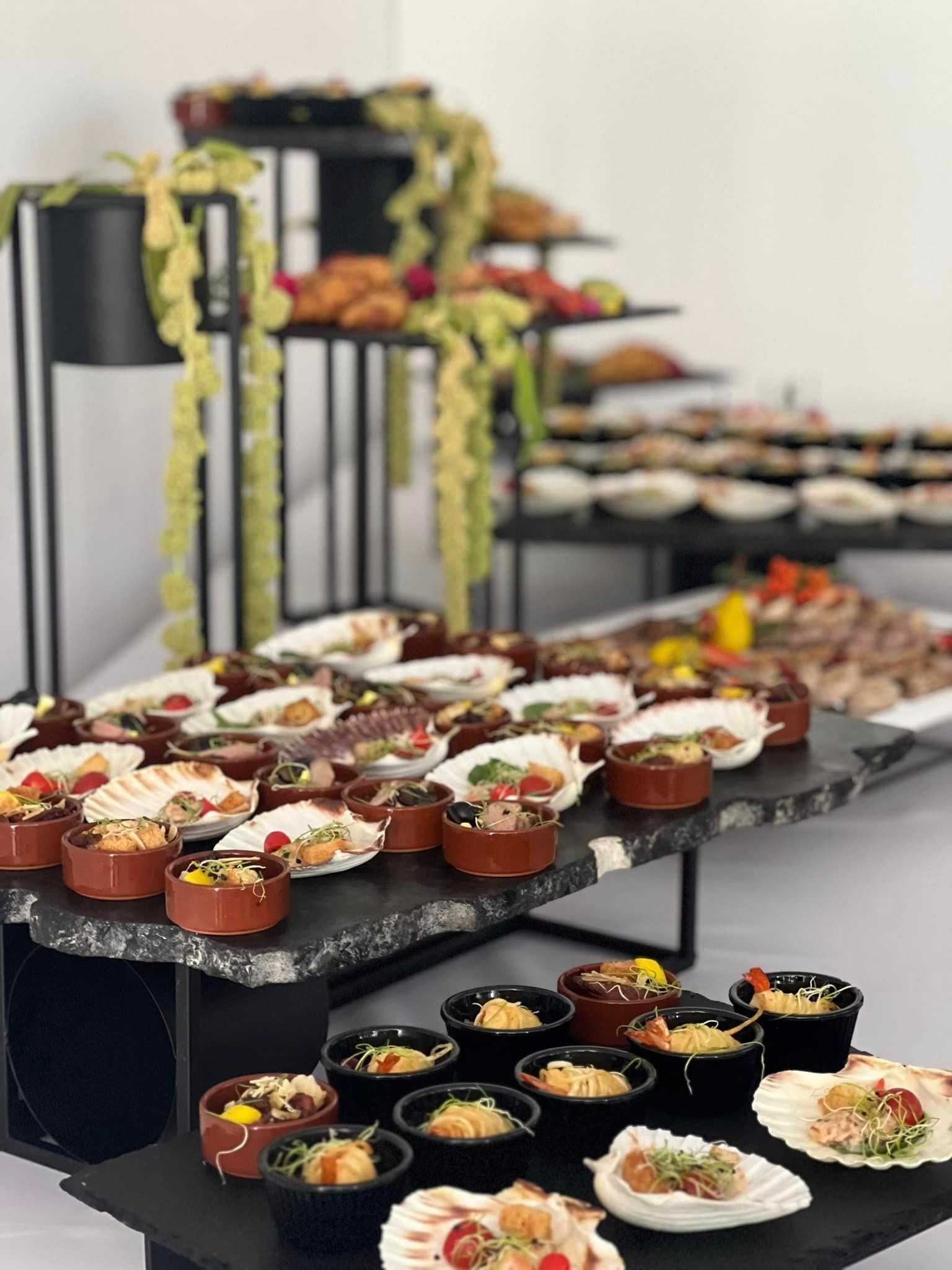
A short format: small bites from the grill and finger food that is easy to eat standing up with a glass in your hand. It suits an after-work gathering on the office terrace or an evening when you invite clients and partners. Say in the invitation that there will be finger food. Otherwise some people will arrive expecting dinner and leave hungry.
Family day
Children eat earlier, eat less and eat differently from adults. They need a separate, simple menu, such as burgers, sausages and chicken skewers, and the grill area has to be well away from where they play. Put children in the budget as a separate line and ask how their price is worked out. You can check how much meat adults and children need with the meat quantity calculator.
All-day event with two meals
When the programme starts at midday and ends in the evening, you cannot leave one buffet out for the whole day. The State Food and Veterinary Service (VMVT) recommendations for catering businesses say cooked food should be kept at room temperature for no more than 2 hours. So I split the day into two rounds: a lighter lunch on arrival and the main dinner from the grill after the programme. In between, water, fruit and snacks are enough to keep people going. The same approach works for a team party with an active programme.
How much does catering for a company summer party cost?
My catering costs €35–65 per person; the exact figure depends on the menu and the number of guests. That is enough for a budget line: multiply by your expected headcount and you have a range you can show to management.
| Company size | Guests | Lower end | Upper end |
|---|---|---|---|
| Small team | 30 | €1,050 | €1,950 |
| Mid-sized company | 100 | €3,500 | €6,500 |
| Large company | 300 | €10,500 | €19,500 |
Where you land within that range depends on the menu and the headcount. Beef steaks or seafood cost more than chicken and pork, so pick the direction of the menu before you ask for a quote. Until you know the exact number of guests, budget for the highest likely figure.
When you compare several quotes, check what the per-person price includes. Caterers count this differently, so ask directly:
- are plates, cutlery and napkins included, and who clears them away;
- how many staff will work the party, and until what time;
- are travel, bringing the equipment and cleaning up afterwards included;
- how children and vegetarian dishes are priced;
- whether the price includes VAT;
- if you are planning two meals, whether the price covers both.
How I work with companies is described on the page about corporate event catering.
Which budget lines do you need to add separately?
The food figure isn't the budget for the whole party yet. Prices for the other lines depend on the venue and the suppliers, so get a quote for each. The table lists what to ask.
| Line | What to ask the supplier |
|---|---|
| Venue | Hire fee and hours; whether grilling is allowed; whether there is a roof, electricity, water and toilets; how late music can play. |
| Drinks | Who supplies soft drinks and alcohol; whether you can bring your own; whether you need a bartender, glasses and ice. |
| Programme and host | Length, technical needs, and whether the programme clashes with mealtimes. |
| Sound and lighting | Whether the venue has its own equipment and how much electrical power it needs. |
| Transport | A coach from Kaunas and back, departure times; parking for those who drive themselves. |
| Marquee or other cover | Size for your headcount, set-up and take-down times, whether it has side walls against the wind. |
| Furniture and tableware | Tables, chairs and tablecloths, if neither the venue nor the caterer provides them. |
| Photographer, decorations, gifts | As needed; decide early so these lines do not turn up in the last week. |
What to book when: a planning timeline counted back from the date
Count back from the day of the party. The first two decisions are the date and the venue; the menu can wait. This is the order I recommend myself. A smaller party can be organised faster; there will just be fewer free dates and venues left.
| Time before the party | What to decide and book | Why then |
|---|---|---|
| 3–4 months | Date and a back-up date; headcount as a range; budget range; who signs off on spending. | Without these four things neither the venue nor any supplier can send you a quote. |
| 2–3 months | Venue and catering booked, deposits paid; wet-weather plan agreed. | Summer Fridays and Saturdays go first, and the wet-weather plan decides what kind of venue you need. |
| 4–6 weeks | Invitation to staff with registration and a dietary survey; transport booked. | People plan their holidays in summer, and collecting survey answers takes time. |
| 2–3 weeks | Menu confirmed based on the survey answers; timed running order for the day. | Mealtimes have to fit around the speeches and the programme. |
| 7–10 days | Final headcount; invoicing details. | This number is what the food is bought for. |
| 2–3 days | Weather forecast and the call on the wet-weather plan; arrival time, access, phone numbers of every supplier. | There is still time to put up a marquee or move the tables. |
| On the day | One contact person on site, with a phone and no other duties. | When something comes up on the spot, every supplier needs to know who to call. |
If the party is a month away, start with two phone calls on the same day: one to the venue and one to the caterer. You can send me an enquiry on the booking page; include the date, the venue and the number of guests. For a December party there is a separate article on a company Christmas party in Kaunas.
What do organisers most often forget?
What usually gets stuck is the logistics nobody asks about until the last week: who does not eat what, where to plug in the equipment, what happens if it rains, and who gives the final headcount.
Dietary and allergy survey
Don't guess how many people don't eat meat. In 2023 LRT, Lithuania's public broadcaster, reported on a survey commissioned by Orkla Foods Lietuva and Gyvi gali, in which just over 8% of people in Lithuania described themselves as flexitarian, pescatarian, vegetarian or vegan. In your company the share could be twice that, or zero, so ask. Put the survey in the invitation itself, so people answer when they register.
Don't skip the allergy question. EU food law lists 14 allergens that must be declared, including cereals containing gluten, milk, eggs, nuts, fish, celery, mustard and sesame. Send the answers to the caterer as a single list together with the final headcount. What to grill for people who do not eat meat is covered in my article on vegetarian dishes on the grill.
Alcohol and getting home
Decide about alcohol before you send the invitation, and say it plainly there: whether there will be any, who is buying it and until what time it is served. Sort out getting home at the same time. If the venue is out of town, a coach from Kaunas and back solves both the driving question and the late-arrival one. Order water and soft drinks with plenty to spare, especially if hot weather is forecast.
Rain and where the grill goes
According to the Lithuanian Hydrometeorological Service, July is the wettest month of the year: the 1991–2020 normal for Lithuania is 84 mm of rain in July, 68 mm in June and 77 mm in August. Plan cover for every summer party, whatever the long-range forecast says. You need it over the buffet and the guests. The grill stays outside, and the food can be served indoors.
If the party is in the office courtyard, find out in advance where the grill can stand. Lithuania's General Fire Safety Rules (Bendrosios gaisrinės saugos taisyklės) allow solid-fuel grills no closer than 6 m to buildings; a Klaipėda City Municipality leaflet for residents repeats this requirement. Ask the building manager for permission in writing.
Electricity, water and access
I always ask a venue three things: where the nearest power socket is, where the water is, and how close I can drive with the equipment. Countryside homesteads and office courtyards give very different answers, and finding out on the morning of the party is too late. If you are choosing the venue yourself, ask the same questions before you sign the rental agreement. I wrote more about choosing a space and a location in the article on organising an outdoor event.
Final headcount and invoicing
Name one person who confirms the final number of guests, and agree a date after which it no longer changes. When several people send numbers, there is either too much food or too little. Have the company details, VAT number and, if your accounts department requires one, a purchase order number ready for the invoice in advance. I issue an invoice, can sign a contract, and usually ask for a 30% deposit.
Checks before you confirm the order
0 of 11
Frequently asked questions
How much does catering for a company summer party cost?
My catering costs €35–65 per person; the exact figure depends on the menu and the number of guests. For a party of 100 that would come to between €3,500 and €6,500. This is a rough estimate, not a quote. The venue, drinks, programme, transport and marquee are not included, so put them in the budget as separate lines.
How far ahead should we book catering for a company summer party?
I recommend securing the date, venue and catering 3–4 months ahead, because summer Fridays and Saturdays are booked first. The menu can be confirmed later, 2–3 weeks before, once you have the dietary survey answers. Give the final headcount 7–10 days before. If you have less time than that, ask anyway: free dates do come up.
What catering format works for a company party of 100 people?
For 100 people a live grill with a buffet usually works best. Meat and vegetables are grilled on site, guests help themselves to sides and salads, and walking between the grill and the tables brings colleagues from different departments together. A sit-down dinner for that many needs a lot of tables, a roof over all of them and more serving staff, so choose it when a formal programme is the centre of the evening.
What if it rains on the day of the company party?
Have a wet-weather plan from the start: cover for the buffet and the guests, meaning a marquee, a pavilion or a hall nearby. The grill stays outside and the food can be served indoors. Make the call 2–3 days before, based on the forecast. According to the Lithuanian Hydrometeorological Service, July is the wettest month of the year.
How many vegetarian portions should we order for a company party?
As many as your survey shows. Put a question about diet and allergies in the invitation and pass the answers to the caterer together with the final headcount. For reference, in a survey reported by LRT in 2023, just over 8% of people in Lithuania described themselves as flexitarian, pescatarian, vegetarian or vegan. Meat eaters eat grilled vegetables too, so plan them for everyone.
Can we grill in the office courtyard or on a terrace?
A courtyard can work if there is enough space, and the food can still be served indoors. First get permission from the building manager. Lithuania's General Fire Safety Rules allow solid-fuel grills no closer than 6 m to buildings and ban them on terraces unless the grill manufacturer's instructions say otherwise. A tight courtyard may not have room. In that case it is worth moving the party to a countryside homestead (sodyba) or another open-air venue.
Sources
- Lithuanian Hydrometeorological Service: Standard climate normals 1991–2020— average monthly precipitation in Lithuania
- State Food and Veterinary Service (VMVT): “How to cook food properly and avoid cross-contamination?” Recommendations for catering businesses (in Lithuanian)— keeping cooked food at room temperature
- Klaipėda City Municipality: leaflet “How to use a grill safely” (2026) (in Lithuanian)— requirements of the General Fire Safety Rules for solid-fuel grills
- LRT.lt: “Meda, who has not eaten meat for 16 years: people in Lithuania do not realise how our diet affects the climate” (19 October 2023) (in Lithuanian)— survey data from Orkla Foods Lietuva and Gyvi gali on people in Lithuania who do not eat meat
- Food Safety Authority of Ireland: List of 14 Allergens— the allergens that must be declared under EU law